

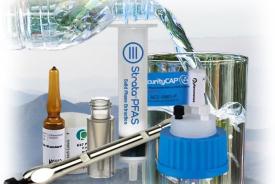
Stacked SPE Cartridges' Advantages for PFAS Analysis
20/10/25
The benefits of using stacked SPE cartridges (typically a combination of a weak anion‐exchange (WAX) sorbent plus a graphitized carbon black (GCB) or carbon sorbent) for the analysis of per‑ and poly‑fluoroalkyl substances (PFAS).
What are stacked SPE cartridges for PFAS?
“Stacked” SPE cartridges mean an SPE device in which two (or more) sorbent materials are layered/combined in series or as a dual‐bed in a single cartridge
Key Benefits
- Simplified workflow / fewer steps
- Improved consistency and reproducibility
- Effective cleanup of complex matrices
- High recoveries across a broad range of PFAS chain lengths and matrices
- Enhanced throughput and cost‐effectiveness for labs
- Regulatory compliance and method compatibility
Why is this particularly advantageous for PFAS?
- PFAS are persistent, low‐level analytes often requiring ultra‐trace detection (ng/L or lower) and are susceptible to matrix interferences. The better the extraction + cleanup, the better the detection limits and data quality.
- The chemical diversity of PFAS (chain lengths, functional groups) means that you need sorbent chemistries tailored to capture both short‐chain and long‐chain, acidic vs non‐acidic species. The combined WAX + carbon approach helps cover that range.
- Because regulatory scrutiny is increasing (e.g., more methods like EPA 1633), laboratories are under pressure for higher throughput, lower detection limits, better QC — stacked SPE supports that demand.